MENU
Explore the Science.
REAL RESEARCH. REAL INSIGHTS.
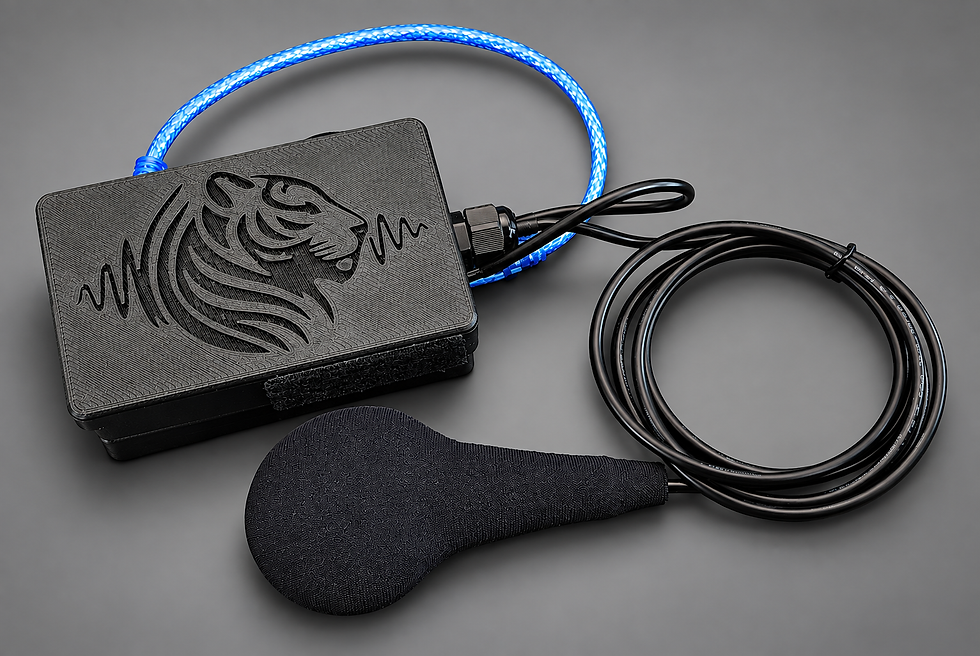
A growing body of research has explored 40 Hz as a gamma-range sensory frequency, including 40 Hz vibration. These studies help inform the science behind TigerTone™, which uses precisely tuned 40 Hz vibration along with sound you hear.
40hz Shows Up in Research
Kantor et al. (2022) · Ref 2: Scoped the vibroacoustic pain literature (20 studies). Protocols were highly heterogeneous, but 40 Hz was the frequency used most often, and sessions typically lasted 20 to 45 minutes. The authors concluded the literature is too sparse to identify which properties of vibroacoustic sessions are beneficial for pain management.
Closest to TigerTone™
These studies use vibroacoustic or low-frequency sound that is both felt and heard — the same sensation class as TigerTone™.
Mosabbir et al. (2020) · Ref 1
Double-blind, placebo-controlled study of a 40 Hz physioacoustic chair with built-in speakers, in a clinical study population.
Closest published controlled study to TigerTone™: fixed 40 Hz vibration you feel, with sound you hear.
Open-label study of 40 Hz vibroacoustic stimulation delivered through transducers built into a lounge, in 19 adults with widespread chronic pain. No control group.
Exact 40 Hz method: vibration you feel, with sound you hear. Furniture form, not a portable unit.
Transducers on hands and feet (16–160 Hz, not fixed 40 Hz) in a small uncontrolled pilot (n=23) in adults with chronic pain.
Fooks & Niebuhr (2024) · Ref 5
Vibroacoustic mattress (20–80 Hz). HRV and EEG signals consistent with increased parasympathetic activity and lower arousal.
Strongest human numbers
The biggest human numbers in the 40 Hz / vibration neighborhood, from different technology.
Meta-analysis of 14 randomized controlled studies (559 people) of whole-body vibration plus exercise in knee osteoarthritis. Pain, function, and knee-extensor strength improved vs exercise alone; stiffness did not. Platforms, not vibroacoustic.
Assessor-blind randomized controlled study (n=89) of whole-body vibration plus exercise for chronic low back pain. Beat exercise alone on pain and disability.
Randomized controlled study (n=69) of vibrating gloves for hand osteoarthritis. Pain intensity lower; frequency in Hz not stated in public abstracts reviewed.
Recovery study (n=84 healthy men). 20–50 Hz vibration massage sped strength recovery vs rest.
The bigger 40 Hz story
Forty hertz is the gamma-range frequency used across sensory-stimulation research.
Suk et al. (2023), MIT · Ref 10
40 Hz whole-body vibrotactile stimulation (vibration the body can feel), studied in mouse models. Mice only; not a human study.
Hajós et al. (2024), OVERTURE · Ref 11
Daily gamma-range light and sound stimulation at home for 6 months in a clinical study population (n≈74–76). Safe, with high adherence. The primary efficacy endpoint did not separate from sham.
Iaccarino et al. (2016) / Martorell et al. (2019) · Refs 12, 13
Foundational mouse studies of gamma-range light and sound stimulation.
Small human feasibility pilot of gamma-range light and sound stimulation (GENUS).
KEY TAKEAWAYS
A GROWING FIELD
Research on 40 Hz vibration and related methods is an active and evolving field.
RELATED METHODS
Studies investigated vibroacoustic devices but did not test TigerTone™ itself, which has not yet been formally studied.
EXPLORE MORE
Use the reference links below to read the full studies.
SELECTED REFERENCES
1. Mosabbir et al., 2020 — 40 Hz physioacoustic chair, PD RCT — https://doi.org/10.3390/healthcare8020113
2. Kantor et al., 2022 — VAT pain scoping review (BMJ Open) — https://doi.org/10.1136/bmjopen-2020-046591
3. Naghdi et al., 2015 — 40 Hz LFSS fibromyalgia — https://pubmed.ncbi.nlm.nih.gov/25545161/
4. Lim et al., 2018 — indirect VAT hands/feet pilot — https://pubmed.ncbi.nlm.nih.gov/30149436/
5. Fooks & Niebuhr, 2024 — VAT mattress stress physiology — https://doi.org/10.3390/s24185924
6. Qiu et al., 2022 — WBV knee OA meta-analysis — https://doi.org/10.2340/jrm.v54.2032
7. Wang et al., 2019 — WBV chronic low back pain RCT — https://doi.org/10.1177/0269215519848076
8. Jamison et al., 2018 — vibrating gloves hand OA — https://doi.org/10.1093/pm/pnx230
9. Chwała et al., 2021 — vibration massage recovery — https://doi.org/10.3390/ijerph182111680
10. Suk et al., 2023 — MIT 40 Hz vibrotactile (mice) — https://doi.org/10.3389/fnagi.2023.1129510
11. Hajós et al., 2024 — OVERTURE 40 Hz AV in AD — https://doi.org/10.3389/fneur.2024.1343588
12. Iaccarino et al., 2016 — Nature 40 Hz light (mice) — https://doi.org/10.1038/nature20587
13. Martorell et al., 2019 — Cell multi-sensory GENUS (mice) — https://doi.org/10.1016/j.cell.2019.02.014
14. Chan et al., 2022 — PLOS ONE GENUS human pilot — https://doi.org/10.1371/journal.pone.0278412
15. Clements-Cortés et al., 2016 — 40 Hz RSS AD pilot — https://doi.org/10.3233/jad-160081
16. King, Almeida & Ahonen, 2009 — short-term PD vibration — https://doi.org/10.3233/NRE-2009-0528
17. Bartel & Mosabbir, 2021 — mechanisms of sound vibration (Healthcare) — https://doi.org/10.3390/healthcare9050597
18. Dong et al., 2019 — WBV chronic musculoskeletal pain meta — https://www.archives-pmr.org/article/S0003-9993(19)30241-2/abstract